Guided Visualization: A Beginner's Guide to Inner Journey Work
By Dr. Paul Wender | May 20, 2026
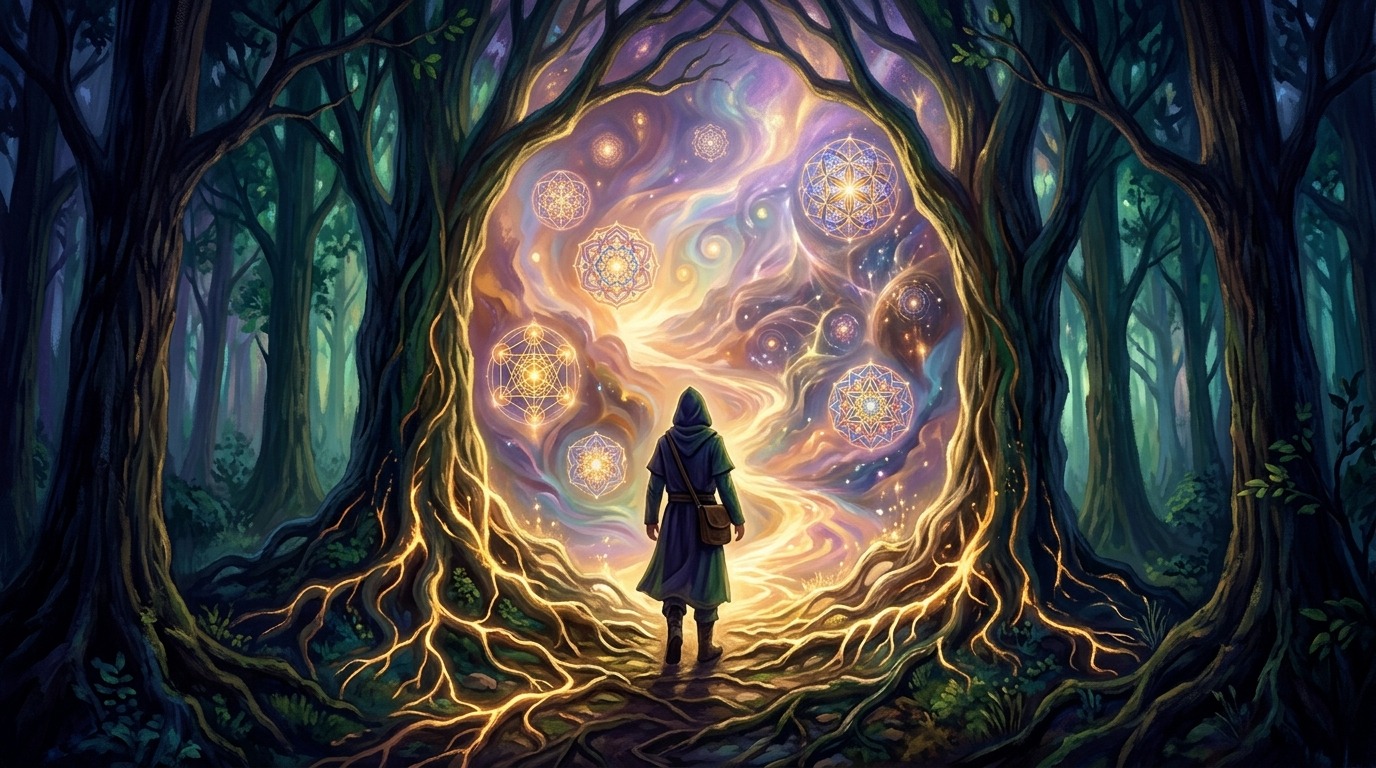
Imagine standing at the edge of a forest. The light is golden, late afternoon, the hour before dusk when everything seems more itself. You can smell the earth. A path leads into the trees. You take one step, then another. And as you walk, something shifts: the ordinary surface of the day falls away, and you find yourself somewhere older, quieter, more real than the room you are sitting in.
This is guided visualization, and it is neither magic nor mere fantasy. It is a well-documented technique that uses the brain's extraordinary capacity for mental imagery to access states of deep relaxation, insight, emotional processing, and inner exploration. Used in clinical settings, sports psychology laboratories, oncology units, and contemplative traditions for decades, guided visualization is one of the most accessible and evidence-supported tools for inner work available to anyone willing to close their eyes and pay attention.
What Guided Visualization Actually Is
Guided visualization is a structured imaginative practice in which a narrator (a therapist, a recording, or an inner prompting) leads the practitioner through a series of imagined scenes or experiences. It shares territory with several adjacent practices:
Meditation: Like meditation, guided visualization involves sustained inward attention and a deliberate quieting of the ordinary mental chatter. Unlike most meditation traditions, it is more directional: the mind is guided toward specific content rather than simply observed.
Hypnosis: Guided visualization uses some of the same mechanisms as clinical hypnosis: focused attention, suggestibility, access to material not easily available in ordinary waking states. The distinction is largely one of context and framing; the neurological overlap is substantial.
Active imagination: Jung's technique of active imagination involves deliberately engaging with inner imagery, allowing figures and scenes to arise and then interacting with them as genuine presences. Guided visualization can serve as an entry point into this deeper practice.
Daydreaming: Guided visualization is more intentional and structured than ordinary daydreaming, but both engage the default mode network (DMN), the brain's "rest state" network associated with self-referential thought, memory consolidation, and creative synthesis.
The Evidence Base
The research on guided imagery and visualization spans several decades and multiple domains:
Anxiety and stress reduction. A clinical review found that guided imagery activates the mind-body connection to enhance well-being, reduce stress, and reduce anxiety, with data supporting these outcomes across multiple patient populations (Naparstek, as reviewed in the clinical literature). Guided imagery has been studied in preoperative anxiety, cancer care, labor and delivery, and outpatient mental health settings.
Pain management. Guided imagery has been shown to reduce perceived pain across a range of conditions. In a randomized controlled study of patients undergoing lower extremity surgery, guided imagery significantly reduced postoperative pain scores compared to control conditions. The posttest mean pain scale score in the guided imagery group was 2.56 versus 4.10 in the control group (p < .001) (Yaman Tunc & Kaya, Orthop Nurs 2023).
Athletic performance. Sports psychology has used mental imagery for decades, and the evidence is robust: imagining a physical performance activates many of the same neural circuits as physically executing it. Elite athletes use visualization as part of their standard training: rehearsing complex movements, managing performance anxiety, building confidence in advance of competition.
Creative problem-solving. Like dreams and hypnagogic states, guided visualization accesses a mode of cognition characterized by reduced prefrontal inhibition and increased associative richness. Complex problems sometimes yield unexpected solutions during visualization practice, the same mechanism that makes dream incubation effective.
Trauma-informed care. Visualization techniques, particularly safe-place imagery and resource installation, are used in EMDR therapy, somatic experiencing, and other trauma-informed approaches as ways to build internal resources and ground the nervous system before processing difficult material.
How to Practice Safely
Guided visualization is generally very safe. A few considerations for beginners:
Choose your time and space. Visualization works best in a comfortable, quiet environment where you won't be interrupted. Set aside 15-30 minutes. Sitting upright is often better than lying down if you tend to fall asleep easily, though either is fine.
Decide on purpose. Are you using visualization for relaxation? For creative incubation? For inner exploration and self-inquiry? The intention shapes the practice. A brief pre-session intention-setting (even a single sentence to yourself about why you are here) improves outcomes.
Move slowly. The most common beginner mistake is moving through the visualization too quickly. Linger in each image. Notice the sensory details: colors, sounds, temperatures, textures. The richer the sensory specificity, the more real the imagined environment becomes, and the more deeply the brain engages.
Allow unexpected content. Guided visualization often surprises. You set out toward a peaceful meadow and find an unexpected figure waiting. A scene you didn't plan appears with unusual vividness. These emergent elements are often the most psychologically significant, the unconscious offering material the conscious mind didn't generate. Follow these threads rather than dismissing them.
Ground afterward. After deep visualization, especially any that brought up strong emotions, take a few minutes before returning to ordinary activity. Feel your feet on the floor. Take a few slow breaths. Drink water. This transition out of the imaginal space is important for integration.
Know when to seek support. Individuals with a history of trauma, psychosis, or severe dissociation should approach deep visualization with professional guidance. Some visualizations can open doors to material that needs more than self-directed processing.
A Simple Starting Visualization
For those new to the practice, here is a structured inner journey to begin with:
Close your eyes. Take three slow, deep breaths: in through the nose, out through the mouth. Let your body settle into whatever surface is supporting it. Feel your weight, your warmth.
Imagine a path in front of you. It can be any kind of path: a forest trail, a beach at low tide, a mountain track, a city street. It doesn't matter which; let your mind choose without judgment.
Begin to walk. Notice what surrounds you: what kind of light, what sounds, what the path feels like under your feet.
As you walk, you arrive at a place that feels right to stop. It might be a clearing, a room, a shore. Take in what's here.
Ask, quietly, if there is anything here for you: any image, figure, feeling, or awareness that wants to emerge. Hold the question without forcing an answer. See what appears.
When you are ready, begin the walk back. Return to the path, the beginning, your breath. Slowly, gently, return.
Write immediately after. Even fragments (a color, a symbol, a feeling) are worth capturing.
Recording Visualization Experiences
One of the most powerful things you can do with guided visualization is build a record over time. Like meditation visions and dreams, visualization experiences are rich in symbolic material that often takes time to understand fully. What seems mysterious or random in a single session may become part of a coherent pattern across many sessions.
DreamJourneys.ai is designed for exactly this purpose: capturing and working with inner experiences, including guided visualization sessions. Its journaling interface supports entry of imaginal experiences alongside dreams and inner journey records, and its AI analysis draws on Jungian and depth-psychological frameworks to help identify what the inner imagery may be communicating.
The image generation feature is particularly valuable for visualization practitioners: after a session, you can describe the landscape, figure, or symbol that appeared, and the platform will generate a visual representation of it. This act of externalization, taking what lived inside and giving it visible form, is a core integration practice and significantly deepens the cognitive and emotional processing of the experience.
Guided Visualization and Integration
For anyone engaged in structured inner journey work, including meditation practice, therapeutic processing, or any form of inner exploration, guided visualization is a powerful integration companion. It allows the practitioner to revisit material from other experiences, to build resources and safe inner spaces, and to continue the dialogue with the unconscious between sessions.
The four stages of dream integration apply equally to visualization experiences: recording, amplifying (enriching the imagery with associations and research), synthesizing (asking what the experience means in the context of your life), and applying (acting on the insights in waking reality).
Visualization makes integration an active, imaginative process rather than merely a cognitive one. And this matters: transformation is not primarily intellectual. It is experiential. The inner journey must be traveled, not just understood.
The Bottom Line
Guided visualization is not mysticism, though it can evoke the numinous. It is not escapism, though it takes you somewhere other than where you started. It is a legitimate, evidence-supported technique for accessing inner states that ordinary waking consciousness can't reach: states of relaxation, creativity, emotional processing, and self-inquiry.
The practice asks very little: a few minutes, a quiet space, a willingness to close your eyes and imagine. What it offers, for those who show up consistently, is something considerably more than relaxation. It is a practice of inner navigation, learning to move through the landscape of the mind with intention and curiosity, rather than just being moved by it.
References
- Yaman Tunc S, Kaya N. The effect of guided imagery on postoperative pain management in patients undergoing lower extremity surgery. Orthop Nurs. 2023.
- Bhalerao V, Gotarkar S, Vishwakarma D, Kanchan S. Recent Insights Into Sleep Paralysis: Mechanisms and Management. Cureus. 2024;16(7):e65413. https://pubmed.ncbi.nlm.nih.gov/39184697/
This content is for educational and inspirational purposes only. DreamJourneys.ai is not a medical or mental health treatment platform. Any journeys, visions, or non-ordinary states of consciousness referenced are assumed to occur within legal frameworks and with appropriate professional guidance. Please consult a qualified mental health professional for therapeutic support.