Relational Integration: Why Healing Doesn't Happen in a Vacuum
By Dr. Paul Wender | May 27, 2026
There is a story we tell about transformative experiences that goes something like this: you go in alone, face the darkness alone, and return alone, changed. The hero descends into the underworld, wrestles the monster, and emerges reborn. No one else can do it for you. The medicine speaks directly to your soul.
This story contains real truth. And it leaves out almost everything that actually matters.
The most profound psychedelic healing you will ever do happens in relationship. Not inside the experience itself, powerful as that is. Not in the days of solitary journaling afterward. It happens when you sit across from another human being, look them in the eye, and say: this is what happened to me, and this is what it meant. And they listen, and they understand, and something in you finally knows it was real.
That is where integration actually lives.
The Myth of the Lone Hero
Psychedelic culture has romanticized solitude. The vision quest. The solo journey into wilderness. The mystic who disappears and returns transformed. There is beauty in these archetypes, and they serve a purpose: they remind us that no one else can do the inner work for us.
But somewhere along the way, the archetype became a prescription. We started treating psychedelic healing as a fundamentally private affair, something that happens between a person and a substance, mediated perhaps by a playlist and a blindfold, resolved through solo journaling and introspection.
This framing, well-intentioned as it is, misses something fundamental about how humans are actually wired.
We are relational creatures. Our nervous systems do not regulate in isolation. Our memories are not static files stored in a private server. They are dynamic, living things that are constantly reshaped by how we tell our stories, to whom we tell them, and how they respond. Healing that happens only inside the skull tends to stay there, cycling and receding without fully integrating into a life.
The most enduring transformation happens when the inner landscape meets the outer world, when the vision becomes a conversation, when the insight becomes a commitment witnessed by another person who cares.
What Genesee Herzberg's Framework Actually Says
In Integral Psychedelic Therapy (Routledge, 2023), therapist and researcher Genesee Herzberg, writing with Jason Butler, makes an argument that challenges some of the dominant assumptions in the field. Their framework, which they call Relational Psychedelic Therapy, places the therapeutic relationship at the center of the healing process, not the substance, not the peak experience, not the neuroscience.
This is a significant claim, and it is backed by decades of psychotherapy research that the psychedelic field sometimes forgets to consult.
Herzberg and Butler draw heavily on attachment theory, interpersonal neurobiology, and relational psychoanalysis to argue that non-ordinary states of consciousness do not create healing in a vacuum. They create conditions of heightened neuroplasticity, emotional openness, and vulnerability. What happens in that window of openness, and with whom it is shared, shapes whether the experience becomes integrated wisdom or unprocessed material that resurfaces as confusion, spiritual bypassing, or re-traumatization.
The therapeutic alliance, in their view, is not a delivery mechanism for the experience. It is the primary engine of integration itself.
The Therapeutic Alliance: More Than a Container
You may have heard the term "set and setting," Timothy Leary's famous shorthand for the psychological and physical context of a psychedelic experience. Set is mindset; setting is environment. It is useful, as far as it goes.
But Herzberg and Butler push further. They argue that within the broader "setting," what matters most is not the room, not the music, not even the intention. It is the quality of the human relationship present.
This is not a soft, unmeasurable claim. It aligns with what we know from decades of psychotherapy outcome research. The therapeutic alliance, defined as the quality of the bond and agreement on goals and tasks between therapist and client, is consistently the strongest predictor of therapeutic outcome across modalities (Wampold & Imel, 2015). Not technique. Not theory. Relationship.
In psychedelic contexts, this effect may be amplified. The heightened emotional sensitivity and suggestibility of non-ordinary states means that the felt quality of the relational field, the therapist's presence, attunement, and genuine care, registers with unusual depth and clarity. Clients often report that a moment of genuine human contact during an experience was as significant as any vision or insight.
What this means practically: the relationship you bring your experience into is not a postscript to the healing. It is part of the healing itself.
Attachment Theory and Why Altered States Activate It
Attachment theory, developed by John Bowlby and later expanded by Mary Ainsworth and scores of researchers since, describes how humans form emotional bonds and how early relational experiences shape lifelong patterns of connection, self-regulation, and meaning-making (Bowlby, 1988).
Most people who have done serious work with non-ordinary states recognize something in this description: altered states tend to surface childhood material. Old wounds resurface. Early relational patterns become visible with unusual clarity. There is often a regression to earlier, more vulnerable ways of experiencing the self and the world.
This is not incidental. It is the mechanism.
Psychedelics appear to temporarily down-regulate the default mode network and reduce the rigid predictive coding that normally filters our perception, which is thought to be why they produce such vivid, unconstrained experiences (Carhart-Harris et al., 2016). But this same opening that enables mystical experience and creative insight also means that the nervous system drops its everyday defenses and becomes, briefly, more like an infant's: open, impressionable, and intensely attuned to relational cues.
When attachment wounding is activated in this state, which it often is, the presence or absence of a safe relational figure matters enormously. A calm, attuned guide can provide a corrective relational experience. A cold, inattentive, or distracted presence can reinforce old wounds.
This is why Herzberg and Butler argue that practitioners working with non-ordinary states need training not just in psychedelic pharmacology or transpersonal theory, but in attachment-based relational skills: attunement, co-regulation, rupture and repair.
The Power of Being Witnessed
There is something specific that happens when you tell your story to someone who is truly present with you. Not someone waiting to respond, not someone analyzing or diagnosing, but someone who is simply, fully there.
Being witnessed is different from being heard. Being heard is cognitive. Being witnessed is somatic. It means another person's nervous system is registering yours. It means your experience is landing somewhere outside yourself. It means you are not alone with what happened.
Psychotherapist and researcher Dan Siegel writes about the experience of "feeling felt," the deep sense that another person is tracking your internal state and meeting it with care (Siegel, 2010). This experience is not just emotionally satisfying. It is neurobiologically meaningful. It activates the integrative circuits of the brain, the same circuits that are central to trauma resolution.
In the context of psychedelic healing, being witnessed in integration is the difference between an experience that remains a vivid but isolated memory and one that becomes woven into the fabric of who you are.
When you tell someone your dream, your vision, your encounter with grief or love or terror in an altered state, and they receive it with genuine attention, something in you recognizes: this happened. This is real. I am changed, and someone else knows it.
That recognition is not a luxury. It is, for many people, the moment integration actually begins.
For more on what integration actually means and why it matters, it is worth starting with the fundamentals before building on them with relational frameworks.
Integration Circles: What They Are and How They Work
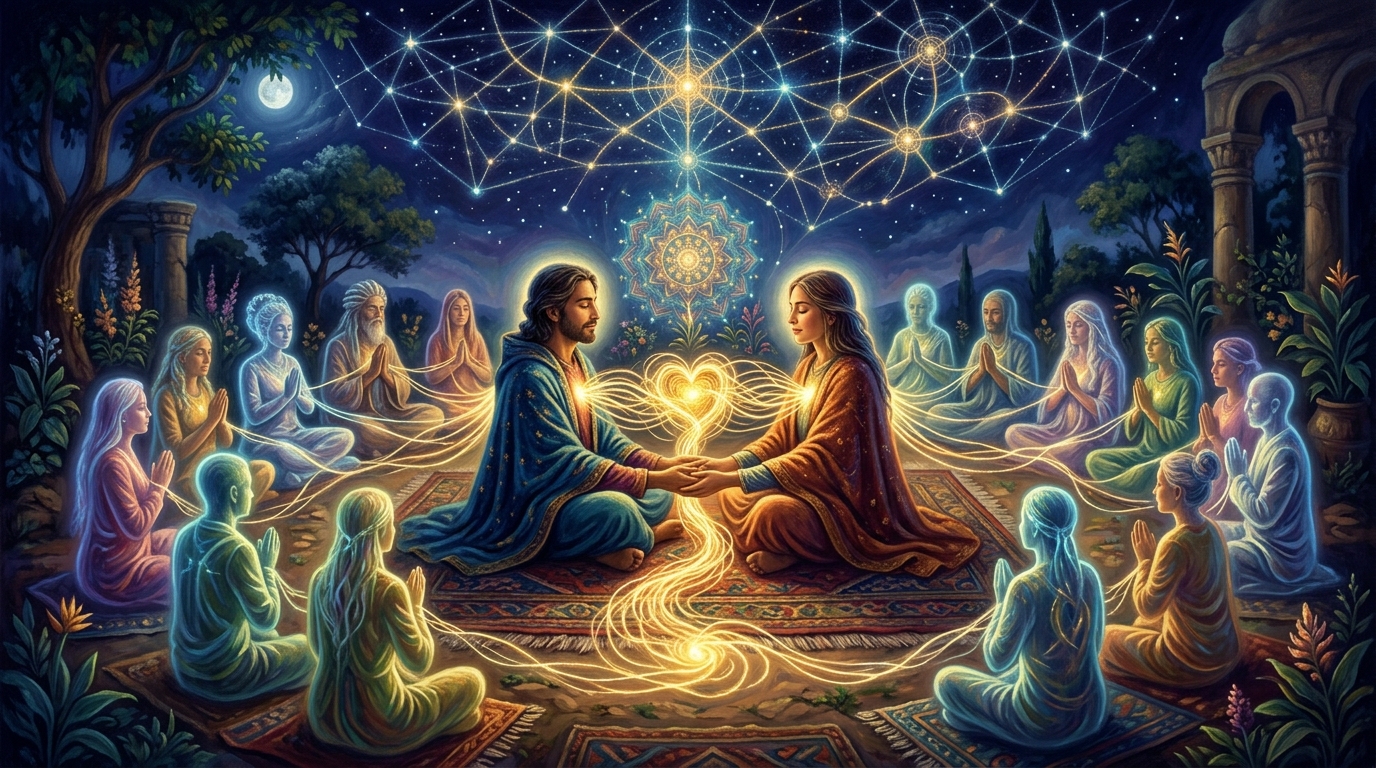
Integration circles are peer-led or facilitated group spaces where people come together after transformative experiences to share what happened, explore what it meant, and receive witness from others who understand.
They are not therapy groups. They are not guided journeys. They are not support groups in the clinical sense. They are something older and more elemental: communities of inquiry, spaces where unusual experiences are treated as meaningful, where the visionary is welcomed rather than pathologized.
In format, integration circles vary widely. Some are loosely structured: people share, others listen, and the facilitator holds the container. Some use somatic practices, breathwork check-ins, or movement to help participants access non-verbal aspects of their experiences. Some incorporate practices from specific traditions. Some are interfaith and secular.
What they share is a fundamental orientation: that the experience you had is worth attending to, that your community is a resource for understanding it, and that you are not alone in navigating the strangeness and beauty and difficulty of profound transformation.
Research on peer support in mental health contexts is clear that community connection is not merely supplementary to healing but foundational to it (Repper & Carter, 2011). Integration circles extend this principle into the specific context of non-ordinary states, providing a relational field that most people cannot find in everyday life, where these experiences remain poorly understood or stigmatized.
If you are doing shadow work prompted by your dreams and visions, bringing that material into a circle can make visible what solitary processing cannot: the ways our wounds are mirrored in others, the collective dimensions of our personal struggles, the relief of discovering we are not uniquely broken.
What Indigenous and Traditional Contexts Always Knew
The idea that integration should be relational and communal is not new. It is ancient.
In virtually every traditional culture that has worked with visionary plant medicines, the experience was embedded in community ritual from beginning to end. The journey itself was conducted in the presence of the community, often for the community's benefit. The aftermath was processed collectively, through ceremony, song, storytelling, and the guidance of elders who had made similar journeys.
The shaman or ceremony leader did not simply administer the medicine and leave. The entire community held the space before, during, and after. The journeyer's experience was understood as meaningful not only to them but to the group. Their visions were consulted for their communal relevance. Their transformation was witnessed and celebrated.
We inherited the tools. We did not always inherit the container.
Contemporary Western psychedelic culture has, in many cases, extracted the experience from this relational and communal context and privatized it. The result, for many people, is a sense of profound opening with inadequate support for what to do with what opened.
Reconnecting with the relational dimension of integration is not nostalgia for something we never had. It is recovering something essential that the medicalized, individualized paradigm can obscure.
Processing Alone vs. Processing in Relationship
Journaling is powerful. Solitary reflection is necessary. The internal work of sitting with what arose, following the threads, letting the meaning slowly surface, cannot be replaced.
But there is a ceiling to what solo processing can accomplish, and it is worth understanding why.
When we process experience alone, we are using only our own existing frameworks to make sense of what happened. Our interpretations are shaped by our habitual patterns of meaning-making, including the distorted ones. Our wounds can masquerade as insights. Our avoidances can look like peace.
Relationship introduces friction. Not conflict, but the productive friction of another perspective, another nervous system, another way of hearing what you just said.
A skilled integration therapist or guide, or even a deeply present and thoughtful peer, can reflect back what they noticed in your telling. They can ask the question you did not know to ask yourself. They can name the thing you circled around without landing on. They can hold the thread you dropped.
This is why the dream journal prompts that generate the most growth are often the ones you then share, not just those you answer and put away. Writing to be understood, even before anyone reads what you wrote, changes the quality of the writing. You find the words for things that had no words before. You discover what you actually think when you have to say it in a way that makes sense to someone else.
Journaling with the intention of sharing, even if sharing is optional, is a fundamentally different act than journaling purely as private release.
How to Find or Create an Integration Community
If you are looking for relational support for your integration work, here is what to look for and where to start.
Formal integration therapists are a growing, if still small, cohort of mental health professionals trained specifically in supporting people after non-ordinary states. Organizations like the Multidisciplinary Association for Psychedelic Studies (MAPS), the California Institute of Integral Studies (CIIS), and others offer training programs and directories.
Integration coaches, distinct from therapists, can be valuable partners for people who do not need clinical support but want a knowledgeable guide. Look for coaches who are transparent about their training, explicit about the limits of coaching versus therapy, and genuinely experienced with the terrain you are navigating.
Integration circles, as described above, can be found through local wellness communities, meditation centers, yoga studios, and increasingly through online platforms. Communities like Psychedelic Support, Integration Circle, and various local harm reduction organizations host regular groups.
If you cannot find a circle, consider starting one. Even two or three people with a shared commitment to showing up regularly, listening well, and holding one another's experiences with care can create something profoundly valuable. You do not need a trained facilitator to create a container. You need agreements: confidentiality, non-advice-giving, presence, and respect for the sacredness of what is shared.
If you are beginning the practice of keeping a dream journal, consider from the beginning who you might eventually share it with. Not because everything needs to be shared, but because writing with a potential witness in mind tends to produce more honest, more complete, more genuinely reflective entries.
The Relational Dimension of AI-Assisted Integration
It would be dishonest to discuss relational integration without acknowledging what it is and is not.
An AI conversation partner is not a human therapist. It does not have a nervous system that co-regulates with yours. It cannot be truly present in the way a person can. The warmth it offers is functional, not felt.
And yet: relationship has a relational dimension even at a remove. The act of articulating your experience to any attentive listener, human or otherwise, changes how you hold it. Writing to be understood is categorically different from writing for no one. Finding words for what happened, and having those words received and reflected back with care and intelligence, has real value in the integration process.
DreamJourneys was built with this understanding. The journaling space is not just a place to store experiences. It is a space to process them, to give them language, to begin the work of making meaning. The AI conversation is not a substitute for human witness. It is a threshold, a place where you can begin to speak what you have not yet spoken, before you are ready to speak it to a person.
For many people, the act of journaling a vision or dream in detail, and then having that material reflected back with Jungian depth and genuine curiosity, serves a real integrative function. It begins the relational process, even before another human enters the picture.
If you are exploring Jungian dream analysis, the DreamJourneys platform can support that work as a companion to, not a replacement for, human relationship.
Share your entries with your therapist. Share them with your integration guide. Bring them to your circle. Let them become the raw material for the relational work that integration actually requires.
Why This Matters Now
The current moment in psychedelic healing is extraordinary and fragile. More people than ever before are having profound transformative experiences, through legal therapeutic frameworks, through decriminalized jurisdictions, through traditional ceremonial contexts, and through the long history of human curiosity that no legal framework has ever fully contained.
Many of these people do not have adequate integration support. They have the experience and nowhere to bring it. They journal alone, struggle alone, and either slowly integrate through resilience and luck, or carry unprocessed material that resurfaces in ways they do not connect to the experience.
The solution is not more solo techniques. It is more relationship. More community. More willingness to show up for one another in the specific way that integration requires: present, non-judgmental, genuinely curious, and committed to the long arc.
Healing does not happen in a vacuum. It happens in the space between one nervous system and another. It happens when someone says "I see you, I hear you, I believe you" and means it.
That space is available to you. The work is finding it, building it, and showing up to it with the seriousness it deserves.
A Note on DreamJourneys
DreamJourneys was built for this work. Whether you are processing a vision, a dream, a meditation, or any non-ordinary experience, the journal is a place to begin giving it language. The AI chat is a place to explore its meaning with depth and care. And the practice of exporting and sharing your entries with a therapist, guide, or integration circle closes the loop: it brings the inner work into relationship.
Start writing. Then share what you wrote. That simple arc, from private to witnessed, is one of the oldest forms of healing there is.
Begin your relational integration practice at DreamJourneys.ai.
References
Bowlby, J. (1988). A secure base: Parent-child attachment and healthy human development. Basic Books.
Carhart-Harris, R. L., Muthukumaraswamy, S., Roseman, L., Kaelen, M., Droog, W., Murphy, K., Tagliazucchi, E., Schenberg, E. E., Nest, T., Orban, C., Leech, R., Williams, L. T., Williams, T. M., Bolstridge, M., Sessa, B., McGonigle, J., Sereno, M. I., Nichols, D., Hellyer, P. J., ... Nutt, D. J. (2016). Neural correlates of the psychedelic experience revealed by multimodal neuroimaging. Proceedings of the National Academy of Sciences, 113(17), 4853-4858. (PubMed)
Herzberg, G., & Butler, J. (2023). Relational psychedelic therapy: Attachment, alliance, and the therapeutic relationship. In Integral psychedelic therapy (Ch. 5). Routledge.
Repper, J., & Carter, T. (2011). A review of the literature on peer support in mental health services. Journal of Mental Health, 20(4), 392-411. (PubMed)
Siegel, D. J. (2010). The mindful therapist: A clinician's guide to mindsight and neural integration. W. W. Norton & Company.
Wampold, B. E., & Imel, Z. E. (2015). The great psychotherapy debate: The evidence for what makes psychotherapy work (2nd ed.). Routledge.
This content is for educational and inspirational purposes only. DreamJourneys.ai is not a medical or mental health treatment platform. Any journeys, visions, or non-ordinary states of consciousness referenced are assumed to occur within legal frameworks and with appropriate professional guidance. Please consult a qualified mental health professional for therapeutic support.